
Science
The following are the main science case drivers of TAMBO:
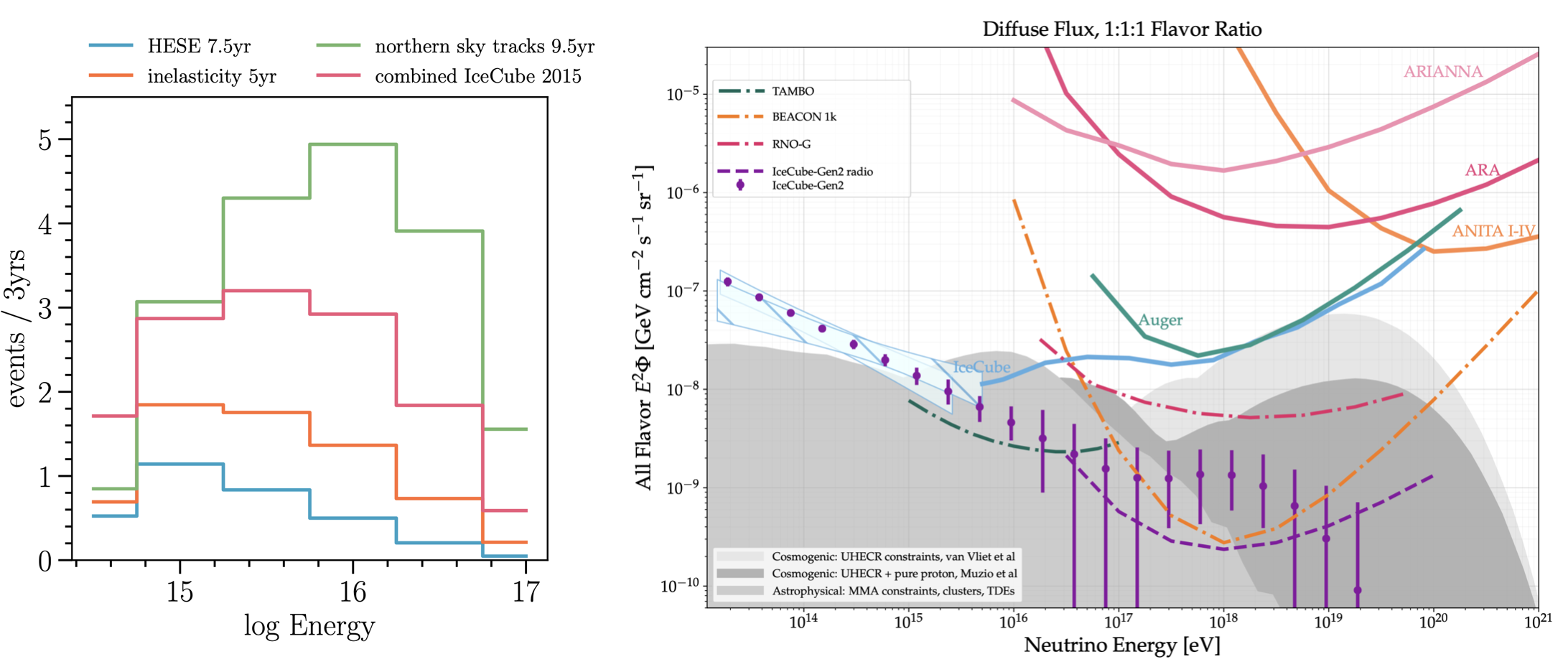
Measurement of the astrophysical diffuse tau-neutrino Spectrum: Determine whether high-energy neutrino sources continue to accelerate particles above 10 PeV. TAMBO bridges the energy regime that connects current high-energy astrophysical neutrino measurements by IceCube with those that are expected to take place by next-generation radio detectors. TAMBO will also measure the astrophysical neutrino spectrum with a new technique, which has disctinc backtrounds and systematics than those used to currently observe astrophysical neutrinos.
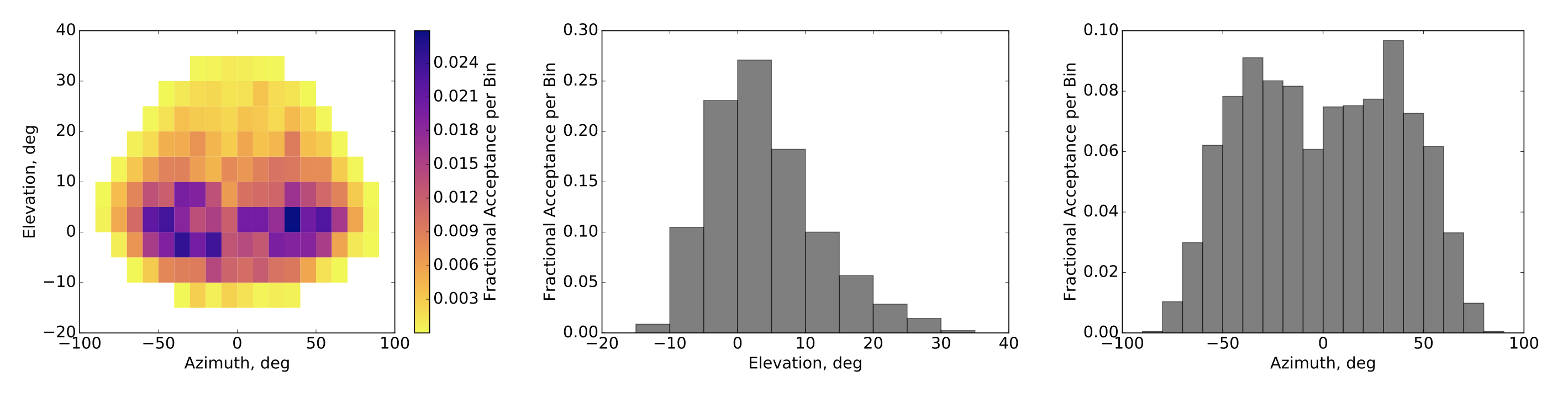
Detection of high-energy neutrino sources: Characterize the astrophysical sources of the neutrino flux between 1-10 PeV by measuring the tau component. This is motivated by multi-messenger observations. The TAMBO sensitivity is focused in a region of 30 degree elevation angle and 120 azimuth, which is complementary to IceCube's nearly all-sky instantaneous field of view in that it would enable a higher point source sensitivity. The region of the sky covered depends on the latitude of the observatory, which can in principle be placed anywhere there is a deep valley of appropriate size. Observations of ντ events from point source transients such as stellar explosions, gamma-ray bursts, AGN flares, and gravitational wave events would provide valuable information on the mechanisms underlying these events.
- Fundamental Physics: The study of high-energy astrophysical neutrino flavor has been shown to be sensitivity to physics beyond the Planck scale. The measurements to be performed by TAMBO will thus have reach to quantum-gravity-motivated parameter space. Additionally, the location of TAMBO in the Southern Hemisphere allows to see the galactic center directly, which can be used to search for annihilation or decay of dark matter to neutrinos. Finally, we will study the interactions of tau neutrinos at new kinematic regimes and other invisible particles that can be produced in cosmic-ray of neutrino interactions such as heavy neutral leptons.